The gaming industry stands at the precipice of a new era, one where artificial intelligence is no longer just a buzzword but an integral collaborator in the creative process. At the heart of this transformation is the emerging role of the AI Level Designer, a hybrid professional who wields machine learning algorithms to craft deeply immersive and dynamically responsive game environments. This isn't about replacing human creativity; it's about augmenting it with a powerful new set of tools that can generate complexity and nuance at a scale previously unimaginable.
Traditionally, level design has been a painstakingly manual process. Designers would block out spaces, populate them with assets, script events, and playtest relentlessly to ensure a balanced and engaging player experience. This method, while effective, is incredibly time-consuming and often limits the scope of what can be achieved. Machine learning shatters these limitations. By training models on vast datasets of successful game levels—analyzing everything from enemy placement and loot distribution to sightlines and pacing—AI can learn the fundamental principles of what makes a level fun, challenging, and memorable.
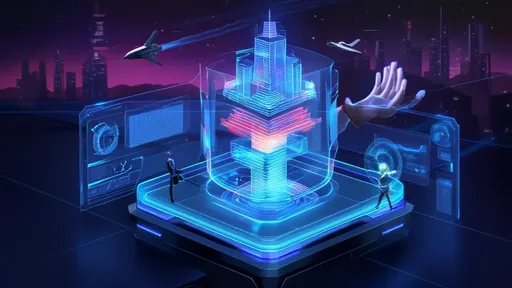
The practical application of this technology is already yielding fascinating results. Procedural content generation (PCG) is being supercharged. Instead of creating levels through purely random algorithms, which can often lead to jarring or unplayable results, AI-driven PCG uses learned design principles to ensure that every generated corridor, arena, and hidden pathway feels intentional and crafted. An AI can generate a thousand variations of a forest level, each with unique topography and vegetation, but all adhering to a core design philosophy that guarantees navigability, strategic depth, and visual cohesion. This allows for the creation of games with near-infinite replayability, where no two playthroughs are ever exactly the same, yet the quality bar remains consistently high.
Perhaps the most profound impact of AI level design is its ability to create adaptive environments. Imagine a horror game where the mansion's layout subtly shifts between playthroughs based on the player's demonstrated fears. If the player shows aversion to tight, enclosed spaces, the AI might generate more of them, heightening the psychological tension. In a strategy game, the terrain could evolve in real-time based on the player's chosen tactics, forcing them to constantly adapt and never rely on a single, tried-and-true strategy. This moves game worlds from being static backdrops to becoming active, participating entities in the narrative, offering a pinnacle of immersion.
Furthermore, this technology is a powerful tool for inclusivity and accessibility. An AI level designer can dynamically adjust difficulty not just by tweaking enemy health points, but by redesigning the environment itself. For a player struggling with a platforming section, the AI could generate additional platforms or wider pathways. For a player seeking a greater challenge, it could remove safety nets and create more complex obstacles. This provides a tailored experience for each individual without the developer having to manually create multiple versions of every level, making games more welcoming to a broader audience.
Of course, this new paradigm is not without its challenges and ethical considerations. A significant concern is the potential for algorithmic bias. If an AI is trained predominantly on a specific genre or style of game, its output may lack diversity and inadvertently homogenize design trends. There is also the fear of the "uncanny valley" of level design—environments that are technically proficient but feel soulless or lacking the quirky, unexpected touches that often come from human ingenuity. The role of the human designer, therefore, evolves from a hands-on builder to a curator, a director, and a trainer of AI systems. Their taste, vision, and creative direction are more important than ever in guiding the AI to produce work that aligns with the game's artistic goals.
The future of this field is dazzlingly bright. We are moving towards a collaborative model where a designer can provide a high-concept prompt—"a derelict space station that feels claustrophobic and tells a story of a sudden disaster"—and the AI can generate a multitude of fully realized, playable prototypes in minutes. The designer can then refine, edit, and inject narrative details, using the AI as a powerful ideation and prototyping engine. This drastically accelerates development cycles and frees up human creativity to focus on high-level storytelling, emotional pacing, and pure artistic innovation.
In conclusion, the integration of machine learning into level design is not a threat to the artistry of game development but its next great enabler. The AI Level Designer represents a symbiotic partnership between human and machine. It leverages the computational power of AI to handle scale and complexity while relying on human intuition for vision and soul. This collaboration is paving the way for a new generation of games: worlds that are vast, intelligent, deeply personal, and more immersive than ever before. The digital realms we explore tomorrow will not just be built; they will be learned, adapted, and grown.
By /Aug 26, 2025

By /Aug 26, 2025
By /Aug 26, 2025
By /Aug 26, 2025

By /Aug 26, 2025

By /Aug 26, 2025

By /Aug 26, 2025

By /Aug 26, 2025
By /Aug 26, 2025
By /Aug 26, 2025

By /Aug 26, 2025
By /Aug 26, 2025
By /Aug 26, 2025

By /Aug 26, 2025

By /Aug 26, 2025
By /Aug 26, 2025

By /Aug 26, 2025

By /Aug 26, 2025

By /Aug 26, 2025
By /Aug 26, 2025
