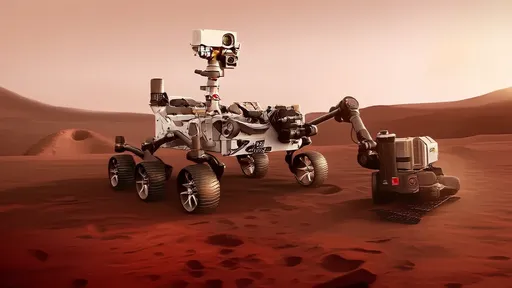
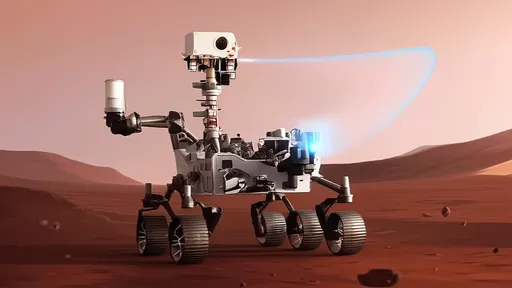
Against the rusty-red backdrop of the Martian landscape, a robotic arm extends with delicate precision. Its titanium drill bit whirs to life, biting into the ancient, alien rock. This is not a scene from science fiction; it is the daily work of NASA's Perseverance rover, and its latest achievement marks a pivotal moment in humanity's quest to understand the cosmos. The rover has successfully collected a series of pristine rock and soil samples, sealing them within ultraclean tubes for a future journey they were never meant to take—a one-way ticket to Earth.
The significance of this operation cannot be overstated. For decades, scientists have studied Mars from a distance, analyzing data from orbiters and rovers. But to hold a piece of another world in your hands, to subject it to the most powerful analytical instruments on our planet, is an entirely different level of inquiry. Perseverance is not just a rover; it is an interplanetary geologist and the first link in a celestial chain of custody that will span tens of millions of miles. Each sample tube it caches is a time capsule, preserving a record of Martian history that could answer one of humanity's oldest questions: did life ever exist beyond Earth?
The sampling process is a masterpiece of autonomous engineering. The chosen site, the Jezero Crater, was once a vast lakebed, a place where life could have potentially thrived. The rover's sophisticated onboard computers analyze the terrain, selecting a target that promises the richest scientific return. The coring drill, a complex piece of machinery, then bores into the rock, capturing a core sample roughly the size of a piece of classroom chalk. This is the critical moment. Early in the mission, the rover encountered a frustrating setback when its first rock target crumbled to dust, unable to be contained. This recent success, therefore, represents a triumph of problem-solving and robotic resilience. The team on Earth refined their techniques, learning to identify more robust rock types, and Perseverance adapted flawlessly.
Once the sample is secured inside the drill bit, it begins a carefully choreographed dance within the rover's belly. A complex system of robotic transfers moves the core from the drill into one of the 43 hermetic sample tubes carried by Perseverance. Each tube, made of ultrapure materials to prevent contamination, is then hermetically sealed. The rover doesn't just drop them on the ground; it places them in a meticulously documented cache on the surface, creating a primary deposit of priceless geological treasures. The precision of this operation is staggering. These tubes must be retrievable by another mission, years from now, so their placement and documentation are as crucial as their contents.
So, what secrets might these small cylinders of rock and regolith hold? Scientists are poring over the data, but the initial targets are rich in clay minerals. On Earth, clays form in the presence of water and are excellent at preserving organic matter and biosignatures—the chemical hallmarks of life. By studying these samples, geologists will be able to date the rocks with a precision impossible from orbit, determining exactly when Jezero Crater held water. They will analyze the mineralogy and chemistry for any trace of past biological activity. It is a forensic investigation into the history of a planet, with the samples as the ultimate evidence.
The journey for these samples is far from over. Perseverance's current mission is one of collection and caching. The next phase, perhaps the most ambitious robotic space mission ever conceived, is the Mars Sample Return campaign. This multi-launch, international effort led by NASA and the European Space Agency will involve sending a lander to Jezero Crater, equipped with a small fetch rover to pick up the cached tubes. This lander will then contain a small rocket, the Mars Ascent Vehicle, which will launch the sample container into Mars orbit. There, a waiting European-built spacecraft will capture the orbiting sample container and begin the long voyage back to Earth, with a planned landing in the early 2030s.
The challenges are immense. No rocket has ever launched from another planet. No spacecraft has ever rendezvoused in orbit around another world to retrieve a payload. The entire sequence must be executed with robotic autonomy, with no possibility for real-time human intervention. The stakes are equally high, as the samples represent not only a scientific bonanza but also a potential biological hazard, requiring handling in a maximum-security biocontainment facility upon their arrival on Earth. This multi-billion-dollar, multi-agency endeavor is a testament to the global commitment to exploration and the pursuit of knowledge.
Beyond the immediate search for life, the samples will revolutionize our understanding of Mars as a planet. They will provide ground-truth data for the orbital observations that have shaped our current models, revealing the planet's geological diversity, its volcanic history, and the processes that shaped its surface and atmosphere over billions of years. This knowledge is not just academic; it is essential for preparing for future human exploration. Understanding the composition of Martian soil, the presence of resources like water ice, and the environmental conditions is critical for designing habitats and life-support systems for the first astronauts to walk on the red planet.
The success of Perseverance in gathering these samples is a quiet, persistent revolution. While it lacks the dramatic flair of a human landing, its methodical work is laying the groundwork for discoveries that could echo through history. Each sealed tube is a promise to the future, a physical piece of another world waiting to tell its story. It is a story of a wet, potentially habitable past, a story of a changing climate, and perhaps, just perhaps, a story that includes the faint, fossilized whisper of ancient life. The rover continues its trek across Jezero, its drill poised for the next sample, each one a new chapter in the epic tale of Mars, patiently waiting for its journey home.
By /Oct 20, 2025

By /Oct 20, 2025

By /Oct 20, 2025

By /Oct 20, 2025

By /Oct 20, 2025

By /Oct 20, 2025

By /Oct 20, 2025

By /Oct 20, 2025

By /Oct 20, 2025

By /Oct 20, 2025

By /Oct 20, 2025
By /Oct 20, 2025
By /Oct 20, 2025
By /Oct 20, 2025

By /Oct 20, 2025
By /Oct 20, 2025
By /Oct 20, 2025

By /Oct 20, 2025
