The South-to-North Water Diversion Project stands as one of the most ambitious engineering endeavors in human history, a testament to China's determination to address one of its most pressing environmental challenges. Spanning thousands of kilometers, this monumental infrastructure project channels water from the water-rich Yangtze River basin in southern China to the parched northern regions, including the capital Beijing and the surrounding industrial heartlands. While conceived as a domestic solution, the project's scale, technological innovations, and operational framework offer a compelling blueprint for addressing global water scarcity, presenting a model that could be adapted to quench the thirst of other arid regions around the world.
Northern China, home to nearly half the country's population and a significant portion of its agricultural and industrial output, has long grappled with a severe water deficit. Decades of rapid economic growth, intensive farming, and urban expansion have pushed the region's limited water resources to the brink. The Yellow River, once the cradle of Chinese civilization, frequently ran dry before reaching the sea, while groundwater tables plummeted to alarming depths, causing land subsidence in major cities. This crisis threatened not only economic stability but also the very habitability of the region. The South-to-North Water Diversion Project was thus born out of necessity, a strategic response to a problem that could no longer be ignored.
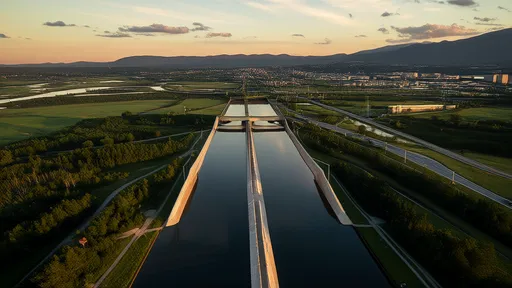
The Central Route of the project, which began full operation in 2014, is its most celebrated and complex component. It starts at the Danjiangkou Reservoir on the Han River, a tributary of the Yangtze, and journeys over 1,400 kilometers northward, crossing the floodplains of the Yellow River and eventually reaching Beijing and Tianjin. Unlike simple canals, this is a sophisticated gravity-fed system. The water flows naturally, descending nearly 100 meters from its source to its destination, a feat that minimizes the need for energy-intensive pumping stations. This elegant engineering solution ensures a continuous and relatively low-cost flow of life-sustaining water.
The construction of the Central Route was a saga of human ingenuity and perseverance. Engineers had to conquer a myriad of geological and technical challenges. They drilled massive tunnels beneath the Yellow River, constructed hundreds of aqueducts and siphons to navigate varied terrain, and built complex water treatment and monitoring facilities to ensure quality. Perhaps the most profound social challenge was the relocation of over 300,000 people to make way for the raised dam and the expanded Danjiangkou Reservoir. This immense undertaking highlighted the significant social and environmental costs that accompany such grand projects, lessons that are crucial for any nation considering a similar path.
The impact of the project on northern China has been transformative. For megacities like Beijing, it has become a vital lifeline, supplying over 70% of the city's tap water and significantly reducing its reliance on over-exploited groundwater. This has allowed aquifers to begin a slow process of recharge, mitigating the risks of land subsidence. For the agricultural and industrial sectors in provinces like Hebei and Henan, the diverted water has bolstered economic security, supporting crop irrigation and manufacturing processes that were previously constrained by water shortages. The project has, in essence, re-engineered the hydrological map of northern China, bringing a new equilibrium to a region on the verge of a water catastrophe.
Looking beyond China's borders, the principles and lessons of this project hold immense global relevance. Many regions of the world face a similar mismatch between water availability and population centers. Arid nations in the Middle East and North Africa, densely populated regions in South Asia, and even water-stressed areas in the western United States could draw valuable insights from the Chinese experience. The South-to-North project demonstrates that large-scale inter-basin water transfer, while immensely challenging, is a viable and powerful tool for national water security. It proves that with sufficient political will, financial investment, and technical capability, geography is not an insurmountable barrier to resource distribution.
However, the project is not a panacea, and its limitations provide equally important lessons for the global community. The enormous financial cost, running into tens of billions of dollars, places it out of reach for many developing nations without international cooperation and funding. The environmental consequences, such as the impact on the ecosystems of the donor region (the Han River) and the challenges of managing water quality over such long distances, underscore the need for comprehensive environmental impact assessments and mitigation strategies. Furthermore, the social upheaval caused by mass relocations highlights the critical importance of fair compensation and robust social support systems for displaced communities.
For a global solution to emerge, the model of the South-to-North Water Diversion must be viewed not as a template to be copied, but as a foundational concept to be adapted. Future international projects could focus on smaller, more manageable scales, connecting neighboring nations with complementary water resources and needs. The focus must also shift towards integrating such mega-projects with local water conservation measures. The most sustainable solution lies in a dual approach: large-scale engineering to rebalance natural resource distribution, coupled with aggressive local policies to promote water-saving technologies, efficient agricultural practices, and the recycling of wastewater. A project that brings water to a city is only truly successful if that city also learns to use every drop wisely.
In conclusion, the South-to-North Water Diversion Project's Central Route is more than a domestic infrastructure achievement; it is a bold statement in the global conversation about water security. It challenges the notion that nations must be passive victims of their geography. While its scale and cost are daunting, it provides a powerful proof-of-concept for using human ingenuity to overcome natural resource constraints. As climate change exacerbates water scarcity for billions of people, the world can no longer afford to view water management within narrow, nationalistic confines. The lesson from China is clear: the future of water security may depend on our willingness to think big, to engineer audaciously, and to manage cooperatively across basins and borders, turning pipelines of water into channels of shared prosperity and resilience.

By /Oct 20, 2025

By /Oct 20, 2025

By /Oct 20, 2025

By /Oct 20, 2025
By /Oct 20, 2025
By /Oct 20, 2025

By /Oct 20, 2025

By /Oct 20, 2025

By /Oct 20, 2025

By /Oct 20, 2025

By /Oct 20, 2025

By /Oct 20, 2025
By /Oct 20, 2025
By /Oct 20, 2025

By /Oct 20, 2025

By /Oct 20, 2025
By /Oct 20, 2025

By /Oct 20, 2025
